
Function-Led Delivery: Dismantling Professional Gatekeeping
Part 2 of the Rural Health Equity Framework series for paid subscribers

Last week I explored Rural-First Design and how geographical narcissism shapes health systems from urban centres outward. This week, I’m diving into the second component of the Rural Health Equity Framework: Function-Led Delivery.
When Form Trumps Function
In rural health, we have a problem with professional gatekeeping.
Not the dramatic kind - no one’s standing at the door turning people away. It’s subtler than that. It’s the quiet assumption that certain work “belongs” to certain professions, regardless of whether that serves the community’s needs.
It’s nurse specialist roles that inadvertently block Allied Health professionals from practicing at their trained scope. It’s GPs refusing collaborative practice claiming they “don’t have time to supervise” professions that don’t legally require supervision. It’s city-based therapists telling rural parents their child won’t get quality care from rural colleagues.
This is what I call prioritising form over function.
Form is the form of the profession that people associate with healthcare. The media, members of the public, health system administrators, politicians - they all talk about nurses and doctors routinely. There are often barriers to delivering health services differently, because the professions delivering the service don’t have the same form as what people are used to. If it’s not a GP, it won’t be as good.
Function is the service delivery itself - what the community actually needs.
In urban settings with workforce density, you can afford to maintain strict professional boundaries. There are enough of each profession to cover their scope. But in rural areas? Professional gatekeeping becomes a barrier to access.
Recent workforce planning research has exposed exactly this problem. Rees, Willis and Scotter’s 2025 analysis in Health Policy argues that traditional workforce planning uses linear forecasting - essentially extrapolating from what we currently have. They advocate instead for normative backcasting: starting with what communities actually need and working backwards to design workforce solutions. Sound familiar? That’s function-led delivery versus profession-led delivery. When we design from professional form (what we currently have, what’s familiar), we perpetuate existing hierarchies. When we design from community function (what’s actually needed), we create sustainable solutions.
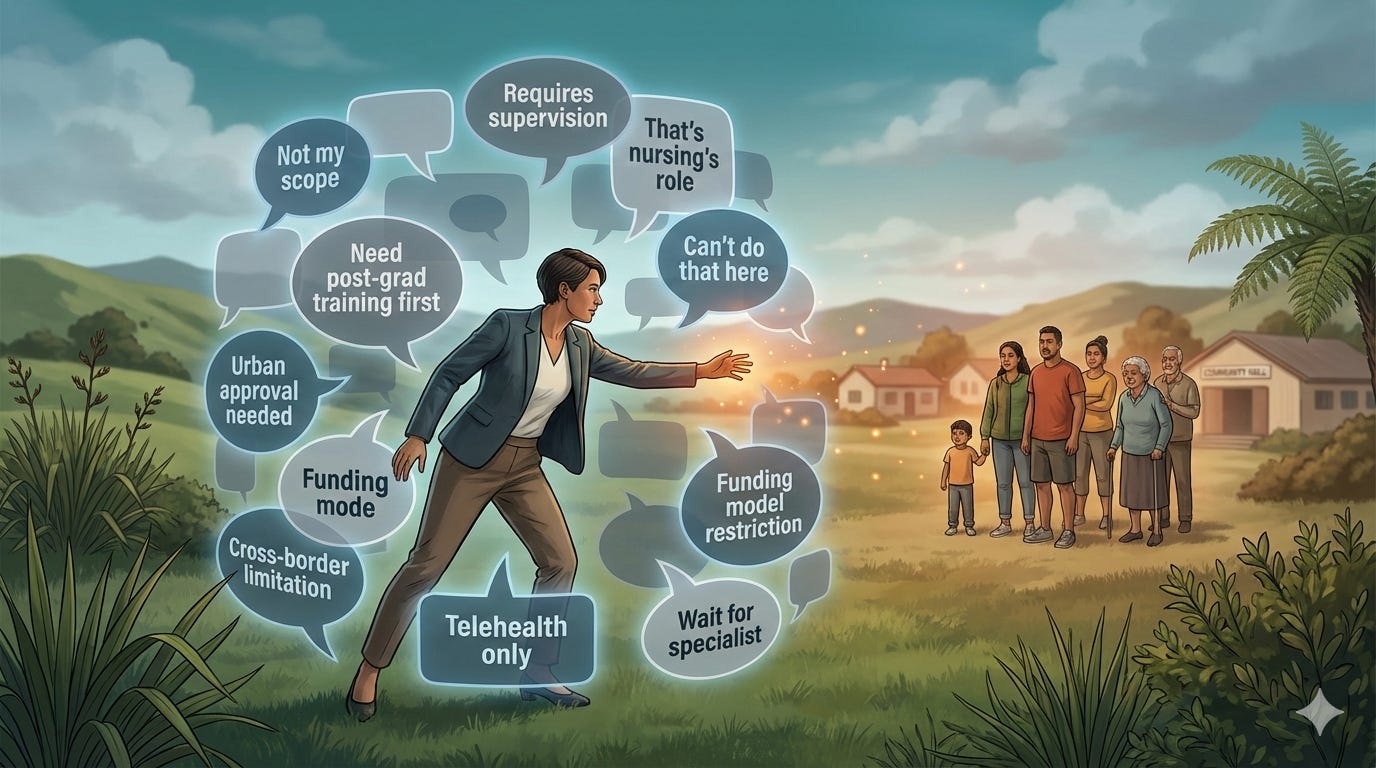
Image generated in Google Gemini
The Evidence of Gatekeeping
Dymmott and colleagues’ 2024 study of the Allied Health Rural Generalist Pathway in Australia found that rural allied health professionals need “broad skills and knowledge to provide vital services to local communities” and must manage “wide ranging and complex health conditions over vast geographical areas.”But here’s where it gets interesting: their research also revealed that “unlike medical training, allied health post-grad training is variable and not directly related to career advancement.” There’s often an “absence of incentives or recognition of learning” that impacts motivation.This creates a perfect storm for professional gatekeeping.When Allied Health professionals lack clear career progression pathways, larger professions step in to fill perceived gaps by creating specialist roles. Well-intentioned. Seemingly practical. But it perpetuates the exact problem it’s trying to solve.
Through my doctoral research with 18 rural Allied Health professionals, I found that professional boundaries designed for urban contexts actively hindered their ability to serve their communities. Participants described being capable of delivering interventions but blocked by professional hierarchy. They spoke of urban-based professionals questioning their competence simply because rural practice looked different from urban norms. The system assumes professional form equals quality, when function is what actually matters.
Keep reading with a 7-day free trial
Subscribe to Allied - Insights for a Thriving Rural Workforce to keep reading this post and get 7 days of free access to the full post archives.